At the Helm: Conversations with the Captain
- Chloe Hambidge

- Jun 9
- 6 min read
Written & Experienced by Chloe Hambidge
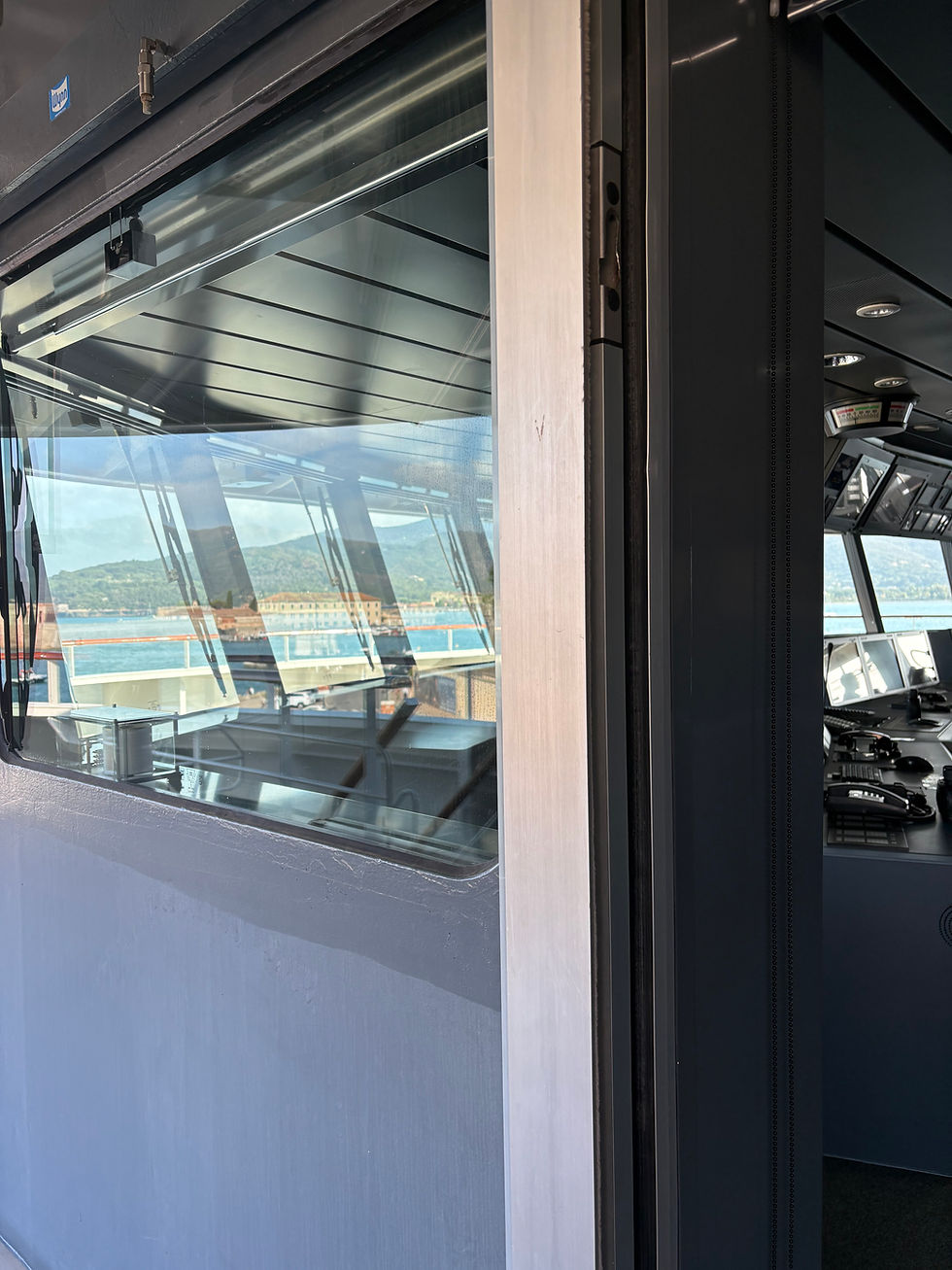
To the left, the pastel-hued bay of Elba curved around us like a horseshoe of Italian charm, yet straight ahead I was met with the clear expanse of the Tyrrhenian Sea. I couldn't have chosen a better vantage point from which to scour this slice of the Tuscan Archipelago, bid farewell to the dolce vita of Portoferraio and pick the brains of Captain Thomas Mc Candless.

From the captains quarters of Le Dumont D'Urville, I felt like a small drop in the ocean. To me, it was an opportunity to gawk at the horizon from my front-row seat behind the nuts and bolts of the bridge. To the captain, it's the workshop where he hones his craft: analysing weather systems, wildlife movements and sea conditions.
After a voyage packed with experimental flavours and expedition elements, one of which allowed us to snake right along the shoreline of Stromboli volcano over our morning pastrie, this behind-the-scenes access was my final nudge towards uncovering the true moments of exploration cruising.
Moments that are priceless.
Moments that follow no plan and, if anything, encourage you to abandon all sense of the word.

The Art of the Detour
For many travellers, a holiday is a place where one seeks comfort, a seamless itinerary and a beach to lounge on.
For an expedition captain, the opposite is often true.
Spectacular, but certainly not always seamless.
When I asked whether Captain Thomas Mc Candless had ever changed an itinerary and simultaneously managed to elevate the guest experience, he merely let out a knowing breath, as if it's just another day in the life.
"The nature of expedition means keeping an open mind," he explained.
He filled me in on a diversion he made during a French Riviera voyage, sailing to Ajaccio instead of Bonifacio as an incoming storm approached. What could have been viewed as an inconvenience was transformed into a highlight, with guests later describing the unexpected stop as their favourite destination of the trip.

The same philosophy was presented to us on a silver platter that very morning, when our route was adjusted to bring us right to the shores of the breathtaking Stromboli volcano, whose shadowed silhouette holds an intimidating presence against the stretching sky. Slightly out of the way of our route, the PONANT team deemed it worth us laying our eyes on it, so they made it happen.
I've learnt that in expedition travel, the destination matters, but the ability to open your eyes to unexpected opportunities is where the true magic happens.
What Guests Don't See
Serendipity usually seems too good to be true, and this instance was no different.
During this particular afternoon, dining at Le Nemo, the grill restaurant, wasn't its usual unhurried affair. Caught up in the drift of eager-eyed guests, it turned out we were sailing right by a pod of dolphins lazing amongst the soft waves.
Surfacing just a stone's throw from the ship, it felt truly spontaneous, and spontaneity is where expedition thrives. Yet there is a method behind the marvel, as the Captain explains:
"I have quartermasters stationed along the bridge who specialise in spotting wildlife. On previous sailings we have adjusted course to allow guests to observe polar bears in the Arctic Circle and whales in Antarctica."
The Freedom of the Sea
Life at sea is unfathomable to most; an almost alluring myth we hear and think about, but wouldn't dare try ourselves.

Yet, when met with the opportunity to pick the brains of the man who leads this vessel year after year, I found myself gravitating towards the need to know why. What made him take the jump?
As he spoke, his posture visibly softened, as if we'd ventured onto safe ground, the sea bringing out this second nature. Until this point we had been discussing logistics, weather systems and itineraries. Suddenly the conversation became honest and profoundly personal.

When touching on what moments at sea brings Captain Thomas Mc Candless the most joy, he fondly states:
"The freedom. It's an escape from the conformist way of life. I am not anti-conformist, but I would consider myself non-conformist. I love to discover, watching the world open up from the bridge knowing new landscapes are never far away."
Which I suppose is what we all desperately seek as travellers: experiences that alter our perspective on life.
Why Expedition Feels Different
Undoubtedly, the expedition way of travel is different, and this is exactly why it should be embraced.
Captain Thomas Mc Candless describes expedition cruising as the opportunity to explore the organised unknown.
Unlike traditional cruising, where precision is measured by adherence to a schedule, expedition voyages are shaped by nature's unpredictability and the slow unfolding of time as these experiences reveal themselves.
"The unknown aspects are all part of the appeal. The discovery, the element of surprise. There is a misconception that the experience is best when planned to perfection, but the advice I give is to expect the unexpected. People who live for experience will be surprised in a good way."

The most fascinating way the Captain explained this to me was when he touched on the polar regions, hidden on the other side of the world:
"Antarctica is one of those destinations that needs consideration and careful contemplation. Expedition offers more freedom and less structure, which we thoroughly enjoy embracing. For example, ice depth can change throughout the day and wildlife follows no rules. We are always anticipating and are ready to adapt to this spontaneity."
This is what expedition cruising really is, and what makes it truly special, is that each experience is different for everyone present.
The Destinations That Keep Calling
After decades at sea and more islands, towns and countries than most of us could count, it's safe to say I was curious whether any destinations could still surprise him.

After a quick back-and-forth about our favourite spots on Earth, it became clear that holding a unique position on the bridge unlocks a whole new perspective when sailing into different destinations. Whether it's a slow sunrise anchor drop or a port-side arrival greeted by a warmly lit seaside town, Captain Thomas Mc Candless reveals his top picks.
"Papua New Guinea and Indonesia. I will never get bored of them. There are so many islands, each home to different cultures and landscapes, as well as ever-changing wildlife that shifts with every nautical mile. New experiences are waiting every time."
It appears the curiosity of sailors never truly dies. Or maybe it's simply expedition that keeps it alive.
The Moral of the Story
As our conversation came to an end, I realised that despite discussing logistics, ship operations and itineraries, the true heart of expedition travel lay beneath the practicalities.
He was talking about curiosity.
The willingness to go against human nature and change course.
The ability to embrace uncertainty.
The belief that some of travel's greatest moments cannot be planned.
It's through PONANT's seafaring DNA: spontaneity, human connection and the freedom of exploration, that this spirit continues to thrive.

Hours later, with the rocky silhouette of Stromboli long behind us and the gala dinner in full swing, conversation around the table kept circling back to the day's discoveries.
Certainty at sea is a foreign concept, and perhaps that's why the best expedition voyages aren't remembered for the ports that were visited, but for the unexpected moments in between.


Comments